 Add to Chrome
 Add to Firefox
 Add to Edge
DeFrame: Debiasing Large Language Models Against Framing Effects
Feb 04, 2026
As large language models (LLMs) are increasingly deployed in real-world applications, ensuring their fair responses across demographics has become crucial. Despite many efforts, an ongoing challenge is hidden bias: LLMs appear fair under standard evaluations, but can produce biased responses outside those evaluation settings. In this paper, we identify framing -- differences in how semantically equivalent prompts are expressed (e.g., "A is better than B" vs. "B is worse than A") -- as an underexplored contributor to this gap. We first introduce the concept of "framing disparity" to quantify the impact of framing on fairness evaluation. By augmenting fairness evaluation benchmarks with alternative framings, we find that (1) fairness scores vary significantly with framing and (2) existing debiasing methods improve overall (i.e., frame-averaged) fairness, but often fail to reduce framing-induced disparities. To address this, we propose a framing-aware debiasing method that encourages LLMs to be more consistent across framings. Experiments demonstrate that our approach reduces overall bias and improves robustness against framing disparities, enabling LLMs to produce fairer and more consistent responses.

Should LLMs, $\textit{like}$, Generate How Users Talk? Building Dialect-Accurate Dialog[ue]s Beyond the American Default with MDial
Jan 30, 2026More than 80% of the 1.6 billion English speakers do not use Standard American English (SAE) and experience higher failure rates and stereotyped responses when interacting with LLMs as a result. Yet multi-dialectal performance remains underexplored. We introduce $\textbf{MDial}$, the first large-scale framework for generating multi-dialectal conversational data encompassing the three pillars of written dialect -- lexical (vocabulary), orthographic (spelling), and morphosyntactic (grammar) features -- for nine English dialects. Partnering with native linguists, we design an annotated and scalable rule-based LLM transformation to ensure precision. Our approach challenges the assumption that models should mirror users' morphosyntactic features, showing that up to 90% of the grammatical features of a dialect should not be reproduced by models. Independent evaluations confirm data quality, with annotators preferring MDial outputs over prior methods in 98% of pairwise comparisons for dialect naturalness. Using this pipeline, we construct the dialect-parallel $\textbf{MDialBench}$mark with 50k+ dialogs, resulting in 97k+ QA pairs, and evaluate 17 LLMs on dialect identification and response generation tasks. Even frontier models achieve under 70% accuracy, fail to reach 50% for Canadian English, and systematically misclassify non-SAE dialects as American or British. As dialect identification underpins natural language understanding, these errors risk cascading failures into downstream tasks.
Explanation Multiplicity in SHAP: Characterization and Assessment
Jan 19, 2026Post-hoc explanations are widely used to justify, contest, and audit automated decisions in high-stakes domains. SHAP, in particular, is often treated as a reliable account of which features drove an individual prediction. Yet SHAP explanations can vary substantially across repeated runs even when the input, task, and trained model are held fixed. We term this phenomenon explanation multiplicity: multiple internally valid but substantively different explanations for the same decision. We present a methodology to characterize multiplicity in feature-attribution explanations and to disentangle sources due to model training/selection from stochasticity intrinsic to the explanation pipeline. We further show that apparent stability depends on the metric: magnitude-based distances can remain near zero while rank-based measures reveal substantial churn in the identity and ordering of top features. To contextualize observed disagreement, we derive randomized baseline values under plausible null models. Across datasets, model classes, and confidence regimes, we find explanation multiplicity is pervasive and persists even for high-confidence predictions, highlighting the need for metrics and baselines that match the intended use of explanations.
Classroom AI: Large Language Models as Grade-Specific Teachers
Jan 09, 2026Large Language Models (LLMs) offer a promising solution to complement traditional teaching and address global teacher shortages that affect hundreds of millions of children, but they fail to provide grade-appropriate responses for students at different educational levels. We introduce a framework for finetuning LLMs to generate age-appropriate educational content across six grade levels, from lower elementary to adult education. Our framework successfully adapts explanations to match students' comprehension capacities without sacrificing factual correctness. This approach integrates seven established readability metrics through a clustering method and builds a comprehensive dataset for grade-specific content generation. Evaluations across multiple datasets with 208 human participants demonstrate substantial improvements in grade-level alignment, achieving a 35.64 percentage point increase compared to prompt-based methods while maintaining response accuracy. AI-assisted learning tailored to different grade levels has the potential to advance educational engagement and equity.
SHAP-based Explanations are Sensitive to Feature Representation
May 13, 2025Local feature-based explanations are a key component of the XAI toolkit. These explanations compute feature importance values relative to an ``interpretable'' feature representation. In tabular data, feature values themselves are often considered interpretable. This paper examines the impact of data engineering choices on local feature-based explanations. We demonstrate that simple, common data engineering techniques, such as representing age with a histogram or encoding race in a specific way, can manipulate feature importance as determined by popular methods like SHAP. Notably, the sensitivity of explanations to feature representation can be exploited by adversaries to obscure issues like discrimination. While the intuition behind these results is straightforward, their systematic exploration has been lacking. Previous work has focused on adversarial attacks on feature-based explainers by biasing data or manipulating models. To the best of our knowledge, this is the first study demonstrating that explainers can be misled by standard, seemingly innocuous data engineering techniques.
GradMix: Gradient-based Selective Mixup for Robust Data Augmentation in Class-Incremental Learning
May 13, 2025In the context of continual learning, acquiring new knowledge while maintaining previous knowledge presents a significant challenge. Existing methods often use experience replay techniques that store a small portion of previous task data for training. In experience replay approaches, data augmentation has emerged as a promising strategy to further improve the model performance by mixing limited previous task data with sufficient current task data. However, we theoretically and empirically analyze that training with mixed samples from random sample pairs may harm the knowledge of previous tasks and cause greater catastrophic forgetting. We then propose GradMix, a robust data augmentation method specifically designed for mitigating catastrophic forgetting in class-incremental learning. GradMix performs gradient-based selective mixup using a class-based criterion that mixes only samples from helpful class pairs and not from detrimental class pairs for reducing catastrophic forgetting. Our experiments on various real datasets show that GradMix outperforms data augmentation baselines in accuracy by minimizing the forgetting of previous knowledge.
T-CIL: Temperature Scaling using Adversarial Perturbation for Calibration in Class-Incremental Learning
Mar 28, 2025We study model confidence calibration in class-incremental learning, where models learn from sequential tasks with different class sets. While existing works primarily focus on accuracy, maintaining calibrated confidence has been largely overlooked. Unfortunately, most post-hoc calibration techniques are not designed to work with the limited memories of old-task data typical in class-incremental learning, as retaining a sufficient validation set would be impractical. Thus, we propose T-CIL, a novel temperature scaling approach for class-incremental learning without a validation set for old tasks, that leverages adversarially perturbed exemplars from memory. Directly using exemplars is inadequate for temperature optimization, since they are already used for training. The key idea of T-CIL is to perturb exemplars more strongly for old tasks than for the new task by adjusting the perturbation direction based on feature distance, with the single magnitude determined using the new-task validation set. This strategy makes the perturbation magnitude computed from the new task also applicable to old tasks, leveraging the tendency that the accuracy of old tasks is lower than that of the new task. We empirically show that T-CIL significantly outperforms various baselines in terms of calibration on real datasets and can be integrated with existing class-incremental learning techniques with minimal impact on accuracy.
Better Think with Tables: Leveraging Tables to Enhance Large Language Model Comprehension
Dec 22, 2024


Despite the recent advancement of Large Langauge Models (LLMs), they struggle with complex queries often involving multiple conditions, common in real-world scenarios. We propose Thinking with Tables, a technique that assists LLMs to leverage tables for intermediate thinking aligning with human cognitive behavior. By introducing a pre-instruction that triggers an LLM to organize information in tables, our approach achieves a 40.29\% average relative performance increase, higher robustness, and show generalizability to different requests, conditions, or scenarios. We additionally show the influence of data structuredness for the model by comparing results from four distinct structuring levels that we introduce.
PFGuard: A Generative Framework with Privacy and Fairness Safeguards
Oct 03, 2024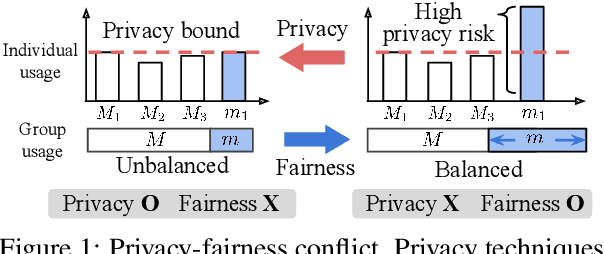


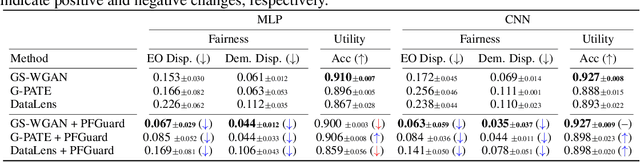
Generative models must ensure both privacy and fairness for Trustworthy AI. While these goals have been pursued separately, recent studies propose to combine existing privacy and fairness techniques to achieve both goals. However, naively combining these techniques can be insufficient due to privacy-fairness conflicts, where a sample in a minority group may be amplified for fairness, only to be suppressed for privacy. We demonstrate how these conflicts lead to adverse effects, such as privacy violations and unexpected fairness-utility tradeoffs. To mitigate these risks, we propose PFGuard, a generative framework with privacy and fairness safeguards, which simultaneously addresses privacy, fairness, and utility. By using an ensemble of multiple teacher models, PFGuard balances privacy-fairness conflicts between fair and private training stages and achieves high utility based on ensemble learning. Extensive experiments show that PFGuard successfully generates synthetic data on high-dimensional data while providing both fairness convergence and strict DP guarantees - the first of its kind to our knowledge.
Fair Class-Incremental Learning using Sample Weighting
Oct 02, 2024Model fairness is becoming important in class-incremental learning for Trustworthy AI. While accuracy has been a central focus in class-incremental learning, fairness has been relatively understudied. However, naively using all the samples of the current task for training results in unfair catastrophic forgetting for certain sensitive groups including classes. We theoretically analyze that forgetting occurs if the average gradient vector of the current task data is in an "opposite direction" compared to the average gradient vector of a sensitive group, which means their inner products are negative. We then propose a fair class-incremental learning framework that adjusts the training weights of current task samples to change the direction of the average gradient vector and thus reduce the forgetting of underperforming groups and achieve fairness. For various group fairness measures, we formulate optimization problems to minimize the overall losses of sensitive groups while minimizing the disparities among them. We also show the problems can be solved with linear programming and propose an efficient Fairness-aware Sample Weighting (FSW) algorithm. Experiments show that FSW achieves better accuracy-fairness tradeoff results than state-of-the-art approaches on real datasets.